

Program pioneers | How do you lead teams and make decisions under uncertainty?


David White didn’t set out to specialize in complex infrastructure programs.
An engineer by qualification, he spent his early years working on water and transportation projects in the U.K., but a pivot in the early 2000s to project management changed that. Since then, his career has unfolded across long-term engagements where the path forward is rarely fully defined, and success depends on aligning people as much as it does on technical delivery. Complex stakeholder groups, evolving scopes and competing organizational interests are the norm in his world, not the exception, and they mean making trade-offs, leading through uncertainty, knowing when to adjust course and getting comfortable with constant recalibration.
For David, program management is less about strict repeatable processes and more about situational judgement and flexibility — more art than science.
From working on the Strategic Tunnel Enhancement Program (STEP) in Abu Dhabi through the global financial crisis to supporting New Zealand’s largest ever wastewater infrastructure project, Central Interceptor, through the COVID-19 pandemic, David knows first-hand the responsibilities and pressures that come from having a team of people — not to mention a multi-billion dollar pipeline of work — relying on you to guide them through. Over time, he’s learned to navigate these pressures by focusing less on control and more on the people around him; building strong teams, empowering people to make decisions together and and providing calm, consistent leadership during uncertainty and change.
Ask David

David, what does it mean to lead a program?
When clients bring Jacobs in, they’re putting their investment, reputation and ability to deliver outcomes for their own stakeholders in our hands. They expect us to deliver safely, on time and within budget, but leading a program goes beyond these fundamentals.
As a program director, I’m responsible for building a team that can operate effectively over the life of the program and for creating an environment where different organizations can work as one. This often means aligning people who have different priorities, different ways of working and sometimes competing interests. So, a lot of the job is setting a clear direction, managing competing priorities and being consistent in how you show up — because people take their cues from that.
I carry the accountability, but I don’t do the work alone. Success comes from how well the whole team functions, and how clearly everyone understands what we’re trying to achieve together. For me, the right people and the right culture are critical, and both must be actively built, not assumed.
Building the right culture sometimes requires difficult people decisions. For example, I worked on a program that had experienced significant instability and multiple leadership turnovers. Rebuilding team cohesion required realigning team composition and capabilities, complemented by targeted coaching and mentoring to improve collaboration and performance.
It also meant working with the broader team to develop a shared vision, values, behaviors and success factors, and making sure they showed up in day-to-day activities.
What is it about programs that makes them so complex?
For complex programs that span multiple years, the challenge is less about technical difficulty and more about managing uncertainty and alignment.
You rarely start with everything defined. You might have clarity on the near-term scope, but beyond that, the environment is more fluid. Stakeholders change, funding shifts, priorities evolve and unforeseen events happen, and you have to absorb, respond to and manage the impact of changes as they arise.
The COVID-19 pandemic is a great example of this. The Central Interceptor project in New Zealand was mobilizing just as the pandemic began. Borders closed and we faced major disruptions and uncertainty, including the possibility of program termination.
Then there’s the organizational complexity. You’re usually working across multiple partners, sometimes in joint ventures, where each organization has its own commercial drivers. People on the team are often balancing what’s right for the program with what’s expected by their own business. Tension between the two can show up when challenges intensify, particularly around cost, risk and scope discussions. That’s when alignment can slip and decision-making becomes less straightforward.
Navigating those moments is also where you spend most of your time as program director. Not everything neatly fits into a process or contract terms. You’re often working through grey areas, trying to find a way forward that keeps the program moving while keeping important relationships intact.
How has experience changed the way you make decisions?
What I pay attention to has changed with experience. Earlier on, I probably focused far more on the immediate issue that needed to be solved. Over time, you learn the value of noticing the things that sit behind that. A shift in behavior, a breakdown in communication, other small signs that people aren’t aligned or engaged. These are often the early indicators that something’s drifting.
I’ve become more patient and deliberate about how I make decisions. I no longer rush to solve everything immediately. Sometimes, allowing some time and space will get you to a better outcome in the end. I also involve the team more, drawing on different perspectives to understand the implications before moving forward.
That said, you don’t always have the luxury of time or certainty. There’s rarely a perfect answer. It’s about decision-making under uncertainty, making a call based on the information you have, being clear on the trade-offs and being prepared to adjust as circumstances evolve.
Was there a moment that changed how you lead?
Early in my career, I was told I didn’t have enough experience for a role I knew I could do.
I was being put forward for a senior position on a project, and the client’s requirement was based on years of experience. I didn’t meet that threshold at the time. Instead, I was offered a step down, with the understanding that if I proved myself, I’d move into the role later. At the time, it felt like a setback. But I took it, and within 12 months, I stepped into the role I’d originally gone for.
It shifted how I think about progression. You won’t always move in a straight line and readiness isn’t always captured by formal requirements.
That experience also shaped how I work with people now. I try to look beyond whether someone ticks every box and focus on whether they have the capability and potential and then create opportunities for them to grow into the role.
What do you carry forward from one program to the next?
There are a few principles I carry forward from one program to the next.
One is the importance of trust — both building it and giving it. Programs only work when people are willing to be open, to raise issues early and to work through them together.
I think again to the Central Interceptor project in the early days of COVID-19. To keep the program moving forward, we formed a collaborative taskforce with the client and major contractors that met daily to make decisions with imperfect information on how to keep the program moving forward. Often contractual boundaries were set aside to prioritize program outcomes. This turned out to be formative for our program team culture. Through this adversity, we built strong team cohesion and experienced low staff turnover post-pandemic.
Another is empowering the team. You can’t centralize every decision. People need the confidence to act, and that includes being comfortable that not everything will be perfect.
I’ve also learned to recognize progress more consciously. It’s easy to focus on what’s not working, particularly in complex engineering and stakeholder environments, but acknowledging program wide progress and milestones helps build momentum and keeps people engaged.
And underlying all of that is a mindset that all problems can be worked through. Every program has its challenges. The key is staying steady and continuing to move forward.
What remains when you leave a program or the program is over?
The physical outcomes will always be there, but for me, the more enduring impact is the relationships created along the way.
It’s a small industry. You cross paths with the same people again, often years later. So how you work together matters. If people leave a program with a sense that it was collaborative, that they were supported and that they achieved something meaningful, that stays with them. And that’s the part of leadership that carries forward, particularly in complex programs.
What does the future of program management look like for you?
I think program management is becoming more integrated, more informed by data and more dependent on people than ever before.
I’m seeing a shift toward much more connected programs. It’s not enough to manage individual projects anymore — we need to understand how different projects interface, how decisions in one area affect another and how the whole system performs. This level of interconnectedness adds another layer of complexity.
Program management will mirror life in general, and I see a much stronger reliance on data and digital tools. The volume of data available is growing rapidly and the question is: how do we turn data into knowledge? Tools like AI and digital platforms will help us there, processing information and turn it into something useful that helps guide decisions in real time.
I also think stakeholder expectations will continue to rise. Clients are more informed, more connected and more focused on value for money. That means we’ll need to be clearer in how we communicate, more transparent in our decision-making and more consistent in how we demonstrate progress and outcomes.
But despite all of that, I don’t think the fundamentals will change. Programs are still about people. They’re about trust, alignment and bringing different perspectives together to move something forward. If anything, the human elements become more important as complexity increases. Because when you’re dealing with uncertainty, strong relationships, clear judgement and collaboration are what ultimately determines whether a program succeeds.
How would you sum up your approach in one sentence?
You don’t lead a program by having all the answers. You lead it by bringing people together and finding them together.
-
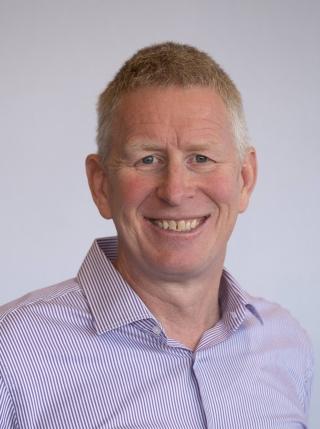
Vice President and Executive Program Director
A global program leader with 30+ years’ experience delivering complex water infrastructure, David leads major projects that support growing communities, combining strong governance, commercial insight and a people-first approach to deliver safe, sustainable outcomes.
